










Pretemporal Pterional Approach for Resection of Pediatric Craniopharyngioma: Surgical Video
Article Sidebar
Main Article Content
Abstract
Introduction: Craniopharyngiomas are rare benign tumors of the sellar and suprasellar region whose close relationship with the optic apparatus, hypothalamus, and pituitary stalk makes surgery particularly challenging. The pretemporal pterional approach provides access through the carotid-oculomotor cistern, offering a wider corridor than the optic-carotid route for retrochiasmatic and third ventricular extension.
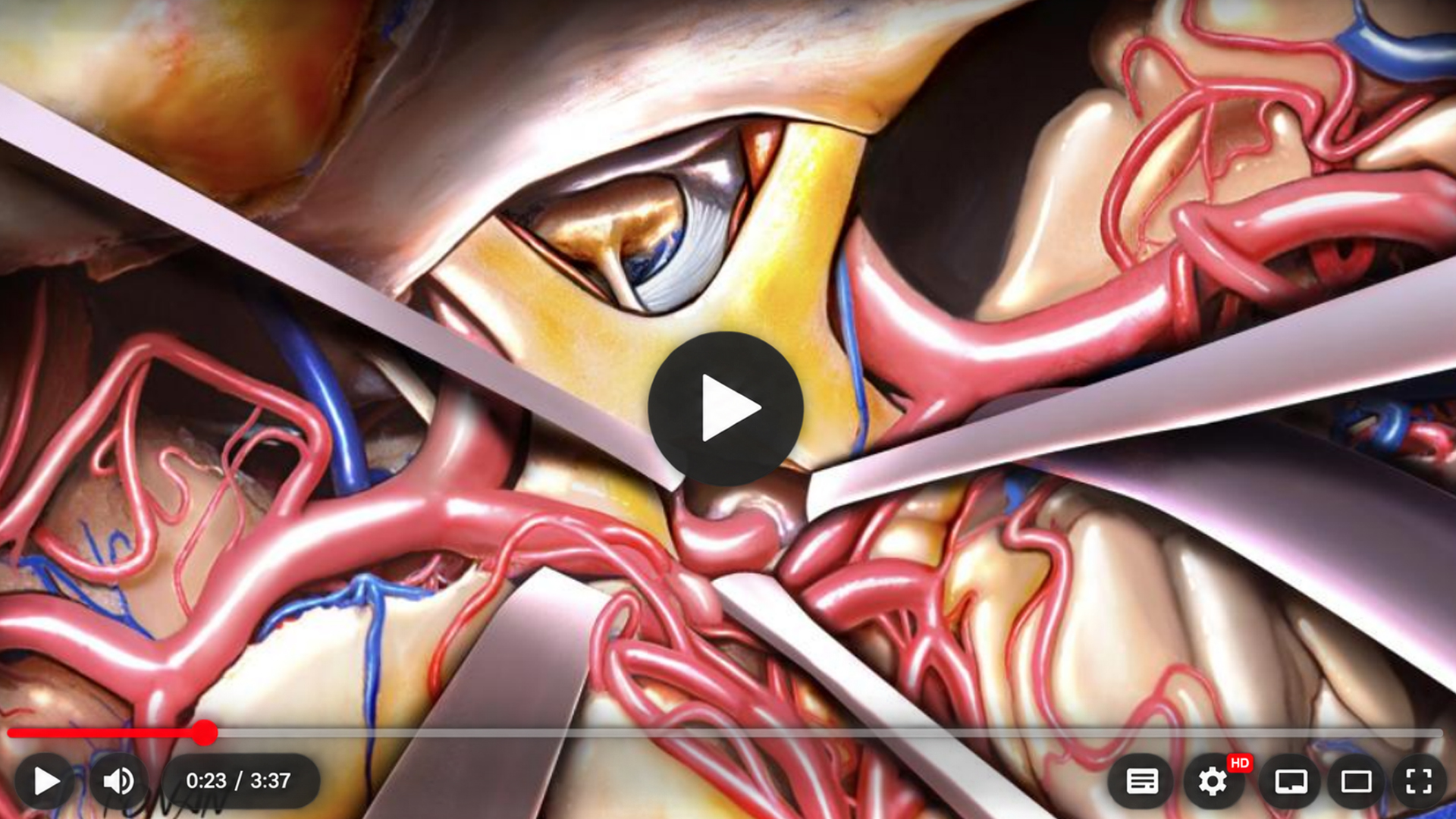
Case Report: A 13-year-old girl presented with visual field loss and normal preoperative endocrine function. CT showed a calcified suprasellar lesion with mild temporal horn dilation, while MRI demonstrated retrochiasmatic extension into the third ventricle. A right pterional craniotomy with a pretemporal approach was selected. Wide Sylvian fissure dissection exposed the optic nerves, right internal carotid artery, and anterior cerebral artery. The optic-carotid corridor was too narrow for safe tumor removal, whereas the carotid-oculomotor cistern provided wider access. The cystic component was decompressed with a butterfly needle, and an ultrasonic aspirator was used to fragment the calcified solid portion. Because the tumor adhered to the pituitary stalk and preoperative endocrine function was normal, the infundibulum was preserved. Meticulous capsular dissection allowed gross total resection with preservation of neurovascular structures and the pituitary stalk.
Results: Postoperative MRI confirmed complete tumor resection with preservation of the pituitary stalk and gland. Transient diabetes insipidus resolved spontaneously, but persistent hormonal dysfunction required long-term replacement therapy. After 15 years of follow-up, no tumor recurrence was observed.
Conclusion: The pretemporal pterional approach provides effective access to retrochiasmatic craniopharyngiomas with third ventricular extension, especially when the optic-carotid corridor is narrow. The wider carotid-oculomotor cistern facilitates resection of large calcified tumors while preserving critical structures. Despite anatomical preservation of the pituitary stalk, postoperative endocrine dysfunction may occur, underscoring the limitations of functional preservation in pediatric craniopharyngioma surgery. The durable 15-year tumor control in this case supports maximal safe resection in selected patients.
Article Details
Section

This work is licensed under a Creative Commons Attribution 4.0 International License.
References
1. de Oliveira E, Tedeschi H, Siqueira MG, Peace DA. The pretemporal approach to the interpeduncular and petroclival regions. Acta Neurochir (Wien). 1995;136(3-4):204-211. https://doi.org/10.1007/BF01410627.
2. Yaşargil MG, Curcic M, Kis M, Siegenthaler G, Teddy PJ, Roth P. Total removal of craniopharyngiomas: approaches and long-term results in 144 patients. J Neurosurg. 1990;73(1):3-11. https://doi.org/10.3171/jns.1990.73.1.0003.
3. Al-Mefty O, Hassounah M, Weaver P, Sakati N, Jinkins JR, Fox JL. Microsurgery for giant craniopharyngiomas in children. Neurosurgery. 1985;17(4):585-595. https://doi.org/10.1227/00006123-198510000-00009.
4. Isolan GR. Tumores do cérebro e da base do crânio: do laboratório de microanatomia neurocirúrgica à sala de cirurgia. 1st ed. Rio de Janeiro: Thieme Revinter; 2026. 812 p. ISBN 9786555723984.
5. Gonçalves RF, de Araújo MB, Delgado JP, Lavinsky J, Schuster AK, Isolan GR. Abordagens multidisciplinares em cirurgias da base do crânio para tumores hipofisários. BioSCIENCE. 2025;83(Suppl 1):e00013. https://doi.org/10.55684/2025.83.S1.e00013.
6. Isolan GR, Polanski JF, Lavinsky J, Pereira FS. Hands-on courses in microsurgical anatomy: innovations for the treatment of skull base diseases. BioSCIENCE. 2025;83:e00033. https://doi.org/10.55684/2025.83.e00033