










About the Journal
-
The Revista Médica do Paraná, after 79 years of uninterrupted publication and fully funded by the Associação Médica do Paraná in Curitiba, PR, Brazil, was restructured and renamed as BioSCIENCE (ISSNe-2764-9350) to fully adapt to open science.
It is a peer-reviewed open access journal and its content is licensed under Creative Commons ( CC-BY ), Attribution 4.0 International.
BioSCIENCE's mission is to promote debate on relevant health issues through the publication of articles of various types based on their originality, contemporary importance and interest to readers. It is committed to the principles of open science, ethics, respect for individuals and experimental animals, humanization, honesty, pioneering spirit and excellence .
The Journal is financially sustainable by promoting diversity, equity, inclusion and accessibility in research. Over time, it will adopt generative AI solutions in its management and editorial processes.
It has its own Statute with details of its origin, institutionality, mission and governance of the journal.
In 2023, starting with volume 80, it will adopt a continuous publication mode and in 2024 it will become bilingual, Portuguese and English.
The abbreviated title is BioSCI . (Curitiba) should be used in bibliographies, footnotes, references and bibliographic captions.
Open Science Compliance
Based on the premise of the Open Science movement and in line with its guidelines, BioSCIENCE adopts a series of practices, such as the open access policy, the code of good practices for editors and credits the contribution of the section editor responsible for the evaluation process in the published article.
Furthermore, it requests the precise indication of the role of each of the authors in articles with multiple authorship, according to CRediT ( Contributor Roles Taxonomy ).
The Journal supports the use of repositories for depositing data that aim at the preservation, dissemination and reuse of data such as SciELO Data .
In line with the open science transparency process, we accept the submission of preprints previously deposited on reliable servers.
The Science Compliance Form prepared by SciELO is available for completion online and helps us improve practices related to Open Science in the journal.
Publication Ethics
BioSCIENCE is committed to the ethical principles recommended by the Committee on Publication Ethics ( COPE ), respect for the individual and the experimental animal, humanization, honesty, pioneering spirit and excellence.
If the work involves the use of human subjects, it must be ensured that it was carried out in accordance with the Declaration of Helsinki of the World Medical Association and Resolution 466/2012 of the National Health Council of Brazil .
If the work involves the use of animals, it must comply with Federal Law No. 11.794/08 or with the DCBA , follow the ARRIVE 2.0 guidelines and the authors must clearly indicate in the manuscript that such guidelines were followed. The sex of the animals must be indicated and, when appropriate, the influence (or association) of this on the results of the study.
For research conducted with living beings or animals, submissions will only be accepted with a letter of approval from a Research and/or Animal Ethics Committee. In the Methods section, it must be stated that the research was approved by an accredited Ethics Committee, together with the National Health Council, and the process number must be provided.
As a common practice in publishing, the use of Turnitin or iThenticate or other upcoming means of checking plagiarism in AI will be maintained, ensuring the originality and integrity of the articles.
In cases where applicable, BioSCIENCE adopts the publication of errata and retractions, aiming at scientific communication that does not generate doubts as to its credibility.
Focus and Scope
BioSCIENCE publishes original, high-quality peer-reviewed scientific papers that contribute to the study of the medical field in its various subareas and interfaces. The Journal is open to contributions from the national and international scientific community and adheres to Open Access .
Digital Preservation
- This journal follows the standards defined in the CARINIANA Network Digital Preservation Policy program .
Indexing sources
- Lilacs (Latin American and Caribbean Literature in Health Sciences)
- Latindex (Regional Information System en Línea Para Revistas Científicas de América Latina, el Caribe, España y Portugal)
- Road ( Directory of Open Access Scholarly Resources )
- Crossref
- Google Scholar
- Sudoc ( System University of Documentation )
- Open Alex
Bibliographic Record
- Journal title: BioSCIENCE
- Short title: (Curitiba)
- Publication by: Paraná Medical Association
- Frequency: Annual
- Publication mode: Continuous Publication
- Year of journal creation: 2022
EDITORIAL POLICY
Peer review process and editorial flow
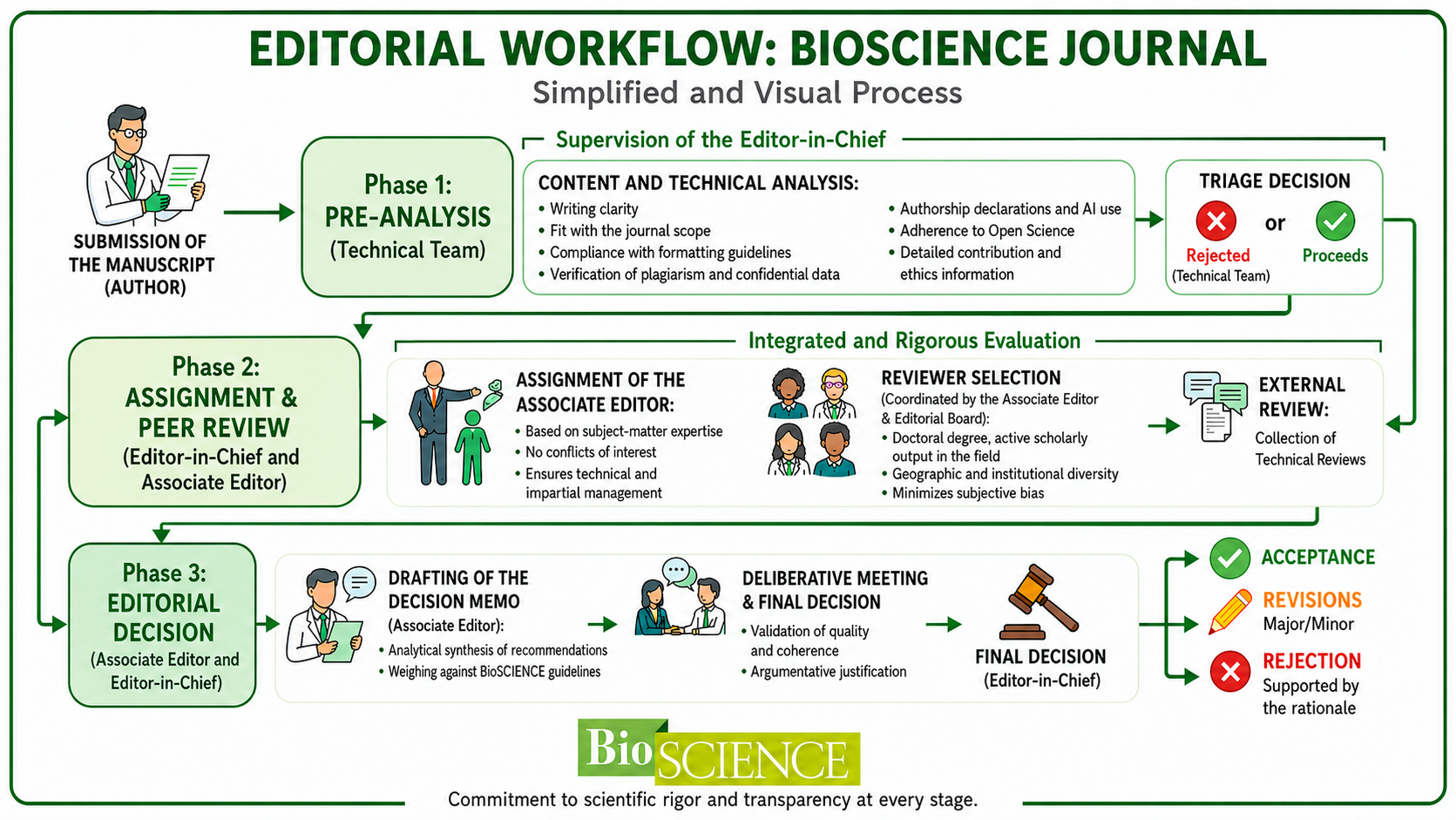
BioSCIENCE's editorial flow begins with the receipt of the manuscript by the technical team, responsible for the preliminary verification of the mandatory documents and for the technical and formal pre-analysis of the submission. In this stage, the clarity of the writing, the adequacy to the scope of the journal, compliance with formatting standards, the presence of authorship statements, conflicts of interest, use of generative artificial intelligence, adherence to Open Science practices, and compliance with the ethical requirements applicable to research are verified. Procedures are also carried out to verify textual similarity, document integrity and identification of confidential information.
After this initial conference, the manuscript is submitted to editorial screening, under the supervision of the editor-in-chief, who evaluates its originality, thematic relevance, academic consistency, methodological adequacy, and contribution to the area of knowledge. At this stage, the editor-in-chief may determine the continuity of the manuscript in the editorial flow or its preliminary rejection, when there is inadequacy to the scope of the journal, evident methodological insufficiency, ethical nonconformity, lack of originality or non-compliance with editorial standards.
Manuscripts approved in the screening are assigned to an associate editor, chosen according to thematic specialty, experience in the area and the absence of conflicts of interest. It is the responsibility of the associate editor to conduct the peer review process, select ad hoc reviewers and/or members of the editorial board with qualifications compatible with the theme of the manuscript, and seek, whenever possible, institutional, geographical, and international diversity in the composition of the review.
BioSCIENCE adopts the double-blind peer review model, ensuring the anonymity of authors and reviewers during the evaluation process. To preserve this model, authorship information must be included exclusively on the title page, which is removed before sending the manuscript to the reviewers. In general, two evaluators with expertise in the topic are invited. When there is substantial divergence between the reviews, the manuscript may be submitted to the appreciation of a third evaluator.
Peer review considers criteria such as originality, thematic relevance, scientific quality, methodological consistency, clarity of presentation, ethical adequacy, relevance of results, and contribution to the area. The opinions issued are examined by the associate editor, who prepares a reasoned editorial recommendation to the editor-in-chief. In case of need for adjustments, the manuscript is returned to the authors for review, and it may be submitted to a new round of evaluation.
In line with its Open Science policy, BioSCIENCE may incorporate practices of openness in the editorial process, when applicable and with the authorization of the participants. Authors and reviewers may inform whether they agree with the disclosure of the content of the reviews, the authors' answers and/or the nominal and institutional identification of the participants in the evaluation process. In the absence of authorization, the content of the reviews and the identity of the evaluators will remain confidential.
The final editorial decision rests with the editor-in-chief, based on the critical analysis of the process, the opinions received and the recommendation of the associate editor. Decisions may result in acceptance, request for minor revisions, request for major revisions, or refusal. The decision is not the result of a mere counting of opinions, but of a reasoned editorial judgment, based on scientific quality, research integrity, methodological consistency, and coherence with the journal's editorial policy.
Rejected manuscripts that have potential for improvement may be reformulated and submitted again as a new submission, initiating a new evaluation flow.
In the approved and published articles, the journal identifies the associate editor responsible for conducting the manuscript, in accordance with its commitment to editorial transparency, traceability of the decision-making process, and good practices in scholarly communication.
Preprints
THE preprint consists of a preliminary version of the manuscript that has not yet been submitted to a journal and has not been reviewed by an editor.
When submitting a manuscript to a preprint server , some precautions must be taken, such as: transparency of the moderation policy, offering the DOI to submitted works, allowing changes to their versions, comments and endorsement from researchers, and interoperability with other platforms.
BiosCIENCE accepts manuscripts deposited in public preprint servers , considered reliable by the editorial committee, such as SciELO Preprints . And follow the Transparency recommendations and Openness Promotion (TOP)
Open data
Open databases are places where public data is stored that can be retrieved, used, modified and shared by others.
To ensure the transferability of data, codes, methods and other materials used and resulting from research, BioSCIENCE supports and encourages authors to share all manuscript data.
It is recommended to consult the Research Data Citation Guide made available by SciELO, the TOP Guide , and for deposit, check the list of repositories for depositing research data made available by SciELO.
Fee Collection
BioSCIENCE does not charge submission, processing and/or publication fees .
Statement of Ethical Commitment and Scientific Integrity
BioSCIENCE guides its activities by the non-negotiable commitment to scientific integrity, editorial transparency and responsibility in the communication of knowledge, basing its policies on the guidelines of the Committee on Publication Ethics (COPE), the recommendations of the International Committee of Medical Journal Editors (ICMJE), the regulations of the National Council for Scientific and Technological Development (CNPq), and the EQUATOR Network.
With regard to authorship, the journal fully adopts the ICMJE criteria, requiring that all authors have contributed substantially to the conception or design of the study, acquisition, analysis or interpretation of data; writing or critical review of intellectual content; final approval of the version to be published; and responsibility for all aspects of the work, ensuring the integrity and accuracy of the information.
All submitted manuscripts must be original, that is, they cannot have been previously published or be under evaluation in another journal. The journal submits 100% of submissions to similarity detection software to identify plagiarism, self-plagiarism, and other forms of misconduct, including fabrication, falsification of data, and improper manipulation of images.
Authors, reviewers, and editors must explicitly state any financial, institutional, or personal conflicts of interest that may influence the editorial process or the interpretation of the results. These statements are mandatory at the time of submission and during the evaluation process.
Research involving human beings or animals must be approved by the Research Ethics Committee (CEP/CONEP or international equivalent), with the indication of the number of the opinion in the manuscript. Clinical studies must present previous registration in recognized databases.
In line with the principles of Open Science, BioSCIENCE strongly encourages the availability of research data, supplementary materials and codes in reliable public repositories, following the FAIR (Findable, Accessible, Interoperable and Reusable) principles. When it is not possible to share data, authors must justify this decision in the manuscript.
The journal accepts manuscripts previously deposited on reliable preprint servers , recognizing their role in accelerating scholarly communication. The use of artificial intelligence tools in the writing must be declared by the authors, and their attribution as authorship is prohibited.
The editorial process is conducted with impartiality, based exclusively on scientific merit, without discrimination of any kind. To promote transparency, the journal publicly identifies the associate editor responsible for conducting each published manuscript.
In the face of suspicions or evidence of scientific misconduct, the journal will strictly follow the international flowcharts recommended by COPE. In case of significant errors or fraud, formal measures will be adopted to correct the scientific record, including errata, expressions of concern and retractions, with due transparency and traceability of versions.
Ethics in publications is essential to maintain quality and trust in the scientific process, protecting the rights and duties of all those involved in the production and dissemination of knowledge. Ethics in academic and scientific publications is a set of principles that aim to ensure the integrity, transparency, and credibility of the scholarly communication process. These standards are essential to promote trust between authors, editors, reviewers, and readers, ensuring that knowledge is produced and disseminated in a responsible manner.
The ethical principles applied by BioSCIENCE in its publications involve all those related to the publication process (authors, reviewers, and editors) who must declare any financial, personal, or professional conflict of interest that may influence judgment or objectivity.
Only people who have contributed significantly to the design, execution, writing, or interpretation of the results should be listed as authors following the criteria emanating from the CRediT Taxonomy (Taxonomy of Authorship Contributions) system. All co-authors must agree with the final version of the manuscript and its submission.
This review must be conducted in an impartial and confidential manner and reviewers cannot use the information from the papers they are evaluating for their own benefit and maintaining the confidentiality of the information, and in addition, reviewers and editors must identify possible conflicts of interest when reviewing the manuscript.
Authors must ensure that the data presented are accurate and complete, allowing other researchers to reproduce the results, making their data available to the scientific community.
All data, ideas, and work that influenced the study should be properly cited. The omission of important references or the inclusion of inappropriate citations may be considered an ethical failure.
BioSCIENCE follows the guidelines for misconduct that are in the Good Practices Guide for Strengthening Ethics in Scientific Publishing : https://wp.scielo.org/wp-content/uploads/Guia-de-Buenas-Practicas-para-el-Fortalecimiento-de-la-Etica-en-la-Publicacion-Cientifica.pdf
When there are errata, they will follow the Guide for the registration and publication of Errata: (Guide for the registration, marking and publication of Addenda): https://wp.scielo.org/wp-content/uploads/guia_adendo.pdf
Retraction: The Journal will follow the Guide for the registration and publication of retractions ( Guide for registering, marking and publishing a retraction (only in Portuguese): https://wp.scielo.org/wp-content/uploads/guia_retratacao.pdf
Conflict of Interest Policy
A conflict of interest is any act that interferes with peer review, editorial decision-making, or the publication of articles.
Authors must explicitly and individually declare any potential conflict of interest, whether direct and/or indirect, financial or non-financial, in a separate document signed and attached to the submission platform.
Ad hoc Reviewers : If a conflict of interest is identified on the part of the reviewers, the Editorial Committee will forward the manuscript to another ad hoc reviewer .
The same criteria are adopted for the area editors and national and international advisors of the Journal, including the editor-in-chief.
If an unreported conflict of interest comes to light after publication, the Journal will act in accordance with COPE guidelines .
For more information see: Disclosure of Financial and Non-Financial Relationships and Activities , and Conflicts of Interest
Adoption of similarity software
All articles are checked through Crossref - Similarity Check to ensure originality.
Adoption of software using Artificial Intelligence resources
BioSCIENCE, in relation to AI systems, follows the guidelines of the Guide for the use of Artificial Intelligence tools and resources in research communication on the SciELO Network.
Sex and gender issues
Individuals’ privacy rights must always be respected. The terms sex and gender must be used correctly. Unless written permission is obtained from the patient (or, where applicable, the next of kin), any patient’s personal data included in any part of the article and in any supplementary materials (including all illustrations and videos) must be removed. Furthermore, BioSCIENCE observes the gender equity policy in the formation of its editorial board.
Ethics Committee
In the Methods item, it must be stated that the research was approved by an accredited Ethics Committee, together with the National Health Council, and the process number must be provided.
In addition, authors must attach a statement of approval from the ethics committee of the institution responsible for approving the research.
Copyright
The authors retain the copyright for the publication of the articles in BioSCIENCE . The articles are protected under a Creative Commons CC BY 4.0 open access license, which means that anyone can download and read the article at no cost. Furthermore, the article may be reused as long as it is cited appropriately. The authors grant the journal the right of first publication.
Intellectual Property and Terms of Use
BioSCIENCE reserves the right to make normative, spelling and grammatical changes to the originals, with a view to maintaining the standard language standards, while respecting the authors' style .
The moral and intellectual rights of the articles belong to their respective authors and are not the property of the journal, which is also not responsible for the opinions expressed by the authors.
All articles published in BioSCIENCE , unless otherwise specified, are protected under a Creative Commons CC BY 4.0 license , allowing distribution, adaptation, and building upon the original work.
BioSCIENCE encourages Authors to self-archive their accepted manuscripts by publishing them on personal blogs, institutional repositories, and academic social media, as well as posting them on their personal social media, provided that full citation to the journal website version is included.
Sponsor
It is sponsored by the Paraná Medical Association , Curitiba, PR, Brazil
BioSCIENCE is a continuation of the title Medical Journal of Paraná .