










Mortality due to meningococcal infection in Brazil: a temporospatialanalysis
Article Sidebar
Main Article Content
Abstract
Introduction: Meningococcal infection characterizes infection by Neisseriaseria meningitidis, Gram-negative bacteria, normally present as commensals in the normal nasopharyngeal microbiota, but potentially pathogenic. The combination of factors such as the specific characteristics and virulence of the strain involved with the host predisposition can culminate in the disease.
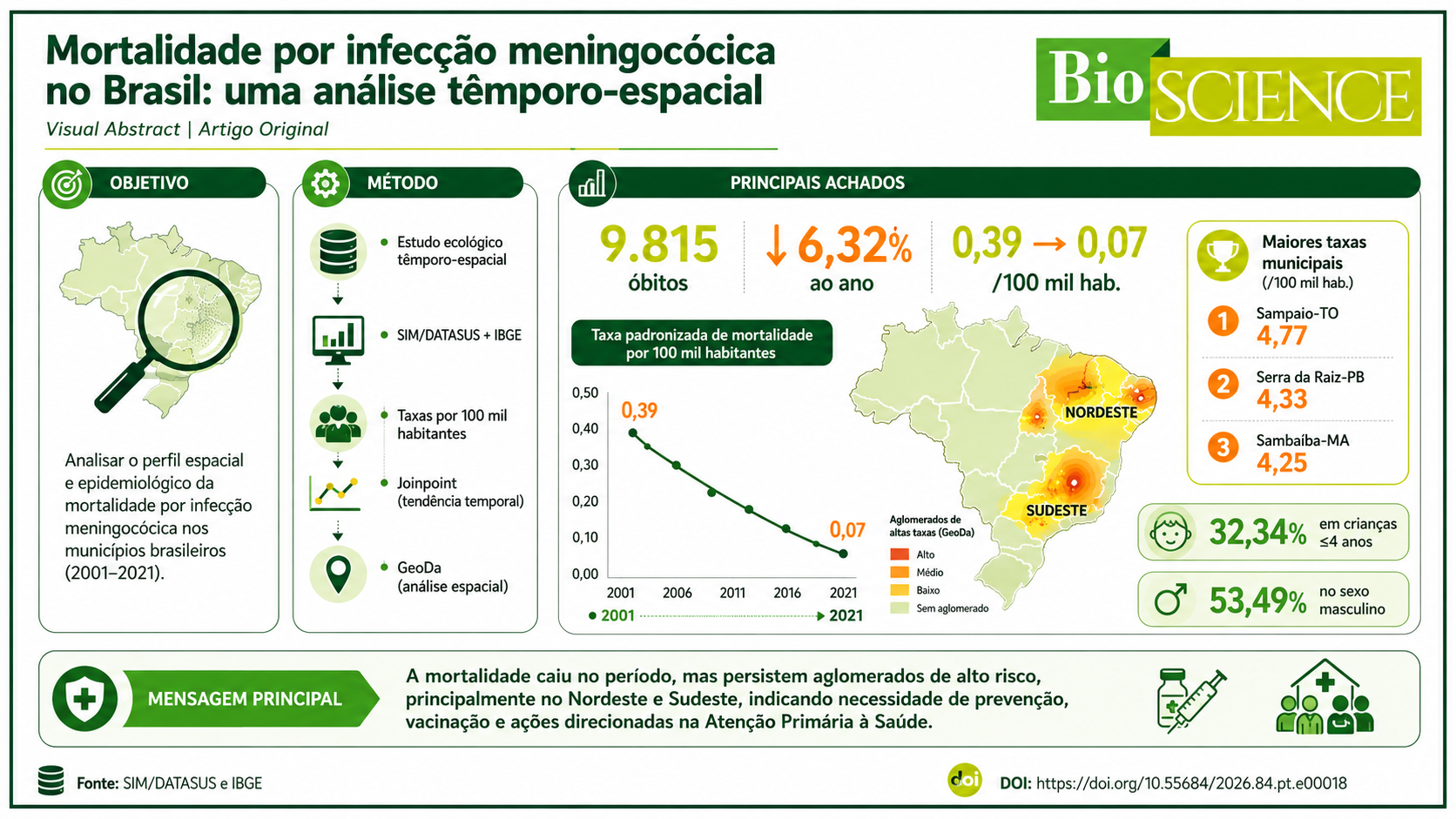
Objective: To analyze the spatial and epidemiological profile of mortality from meningococcal infection in municipalities in Brazil, from 2001 to 2021.
Method: Epidemiological study focusing on the spatial analysis of mortality between 2001 and 2021. Data from the Mortality Information System (SIM), made available by DATASUS, and population data from the Brazilian Institute of Geography and Statistics (IBGE) were used to calculate crude and standardized mortality rates. The temporal analysis was performed using Joinpoint, while the spatial analysis was performed using GeoDa.
Results: There were 9,815 deaths from meningococcal infection in Brazil. The analysis identified clusters of high rates in the Northeast and Southeast regions. The municipalities with the highest rates were Sampaio, TO (4.77/100 thousand inhabitants), Serra da Raiz, PB (4.33/100 thousand) and Sambaíba, MA (4.25/100 thousand).
Conclusion: The study identified municipalities and clusters with high rates and the need for targeted strategies for disease prevention and control.
Article Details
Issue
Section

This work is licensed under a Creative Commons Attribution 4.0 International License.
References
- MacNeil JR, Blain AE, Wang X, Cohn AC. Current Epidemiology and Trends in Meningococcal Disease-United States, 1996-2015. Clin Infect Dis. 2018;66(8):1276-81. https://doi.org/10.1093/cid/cix993
- Willerton L, Lucidarme J, Walker A, Lekshmi A, Clark SA, Walsh L, et al. Antibiotic resistance among invasive Neisseria meningitidis isolates in England, Wales and Northern Ireland (2010/11 to 2018/19). PLoS One. 2021;16(11):e0260677. https://doi.org/10.1371/journal.pone.0260677
- Campsall PA, Laupland KB, Niven DJ. Severe meningococcal infection: a review of epidemiology, diagnosis, and management. Crit Care Clin. 2013;29(3):393-409.
- do Espirito-Santos RR, de Almeida NRC, Campos RALS, Parente F de S, Andrade MCS, Pinheiro ACS de O, et al. Infecção meningocócica em crianças no Brasil: análise do período 2013 a 2017. Brazilian Journal of Health Review. 2021;4(3):9570-8. http://doi.org/10.34119/bjhrv3n4-193
- Berry I, Rubis AB, Howie RL, Sharma S, Marasini D, Marjuki H, et al. Selection of Antibiotics as Prophylaxis for Close Contacts of Patients with Meningococcal Disease in Areas with Ciprofloxacin Resistance - United States, 2024. MMWR Morb Mortal Wkly Rep. 2024;73(5):99-103. https://doi.org/10.15585/mmwr.mm7305a2
- Barroso DE, de Carvalho DM, Nogueira SA, Solari CA. Doença meningocócica: epidemiologia e controle dos casos secundários. Rev Saude Publica. 1998;32(1):89-97. https://doi.org/10.1590/S0034-89101998000100014
- Rausch-Phung EA, Hall WA, Ashong D. Meningococcal Disease (Neisseria meningitidis Infection) StatPearls.; 2026. Available from: https://www.ncbi.nlm.nih.gov/books/NBK549849/
- Silva LRD, Arruda LES, Barreto IJB, Aragão JVR, Silva MLFID, Lira G, et al. Geography and public health: analysis of the epidemiological dynamics of meningitis in Brazil, between 2010 and 2019. Rev Bras Epidemiol. 2024;27:e240031. https://doi.org/10.1590/1980-549720240031
- Green MS, Schwartz N, Peer V. A meta-analytic evaluation of sex differences in meningococcal disease incidence rates in 10 countries. Epidemiol Infect. 2020;148:e246. https://doi.org/10.1017/s0950268820002356