










Determinants of dysphagia after stroke: the role of brain injury location
Article Sidebar
Main Article Content
Abstract
Introduction: Cerebrovascular accident (CVA) is one of the leading causes of death in Brazil and, with the increase in life expectancy of the Brazilian population, sequelae are expected to increase.
Objective: To evaluate the association between brain regions of patients diagnosed with stroke in the chronic phase and the presence of dysphagia.
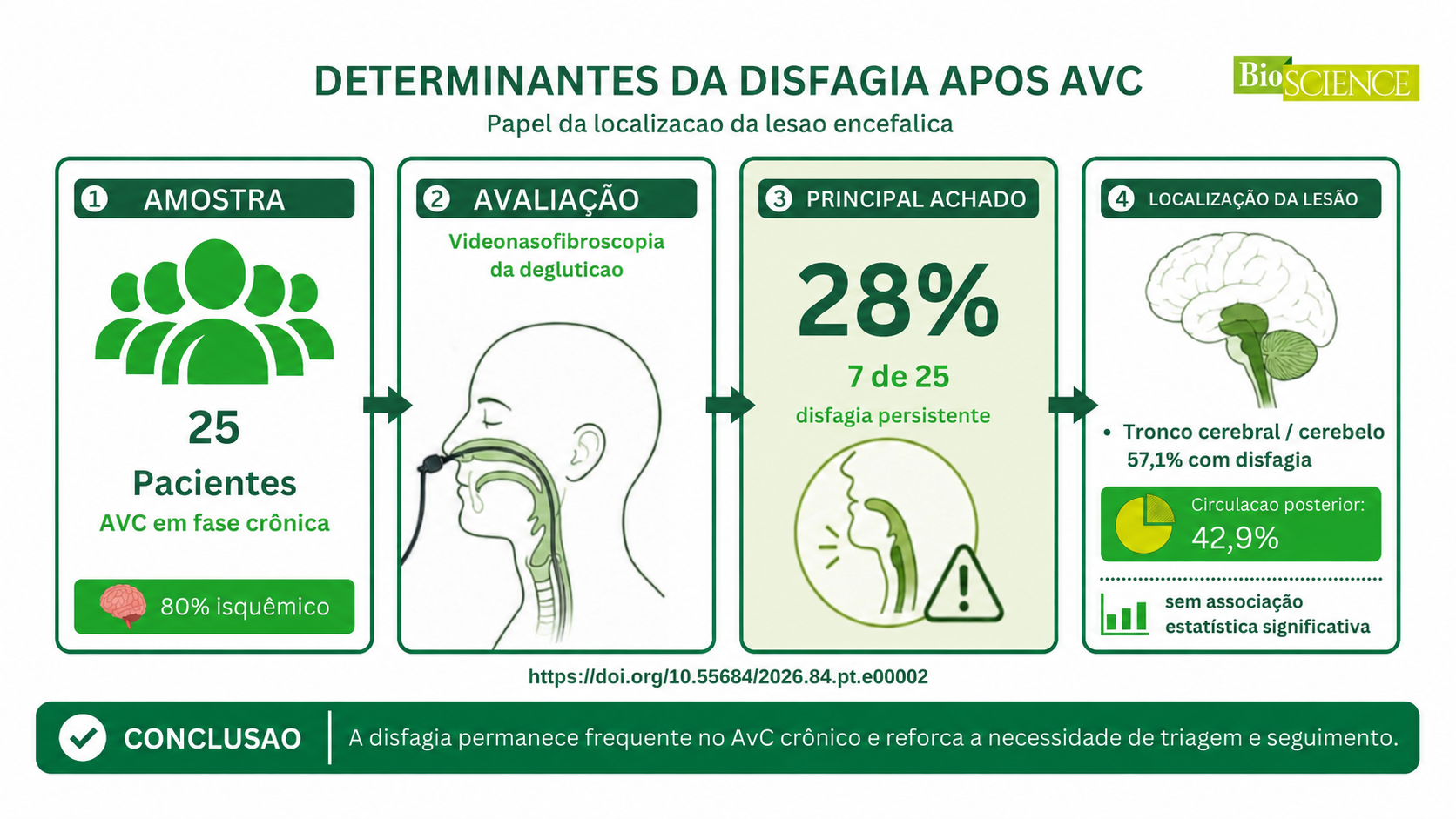
Method: Clinical, cross-sectional, qualitative and quantitative, descriptive and retrospective study with data collection from 25 medical records, in which variables of association between stroke and dysphagia were analyzed, including cause of stroke, diagnosis of dysphagia by videonasofibroscopy of swallowing, compromised brain region and cerebral circulation evaluated by the Swallowing ScaleBamford/ Oxfordshire Community Stroke Project.
Results: Thirteen (52%) patients were men between 61 and 80 years old. Regarding the type of stroke, 20 (80%) were ischemic. Dysphagia remained in seven (28%) in the chronic phase of stroke. There was a predominance of brainstem/ cerebellum lesions and concomitant dysphagia in 57.1% of these patients, and even more frequent ischemia with posterior circulation involvement in 42.9%, but without a statistically significant association.
Conclusion: Patients affected by stroke, in the chronic phase, have a high percentage of dysphagia (28%) in outpatient follow-up.
Article Details
Issue
Section

This work is licensed under a Creative Commons Attribution 4.0 International License.
References
Ministério da Saúde. Secretaria Executiva. Datasus. Informações de saúde. mortalidade e informações epidemiológicas. Disponível em: http://tabnet.datasus.gov.br/cgi/tabcgi.exe?sim/cnv/obt10uf.def.
Tsao, CW, Aday AW, Almazooq ZI, Anderson CAM, Aora P, Avery CL, et al. Heart Disease and Stroke Statistics-2023 Update: A Report from the American Heart Association. Circulation. 2023;47(8):e93-e621. https://doi.org/10.1161/cir.0000000000001123
BRASIL. Comissão Nacional de Incorporação de Tecnologias no Sistema Único De Saúde (CONITEC). Protocolo clínico e diretrizes terapêuticas do Acidente Vascular Cerebral Isquêmico Agudo. Brasília: Ministério da Saúde, 2021.
Organização Mundial da Saúde. O Manual STEPS de Acidentes Vascular Cerebrais da OMS: enfoque passo a passo para a vigilância de acidentes vascular cerebrais/doenças não transmissíveis e saúde mental. Genebra: Organização Mundial da Saúde; 2005.
Brasil. Ministério da Saúde. Secretaria de Atenção à Saúde. Departamento de Ações Programáticas Estratégicas. Diretrizes de atenção à reabilitação da pessoa com acidente vascular cerebral. Brasília: Ministério da Saúde; 2013.
Xerez, DR, Carvalho YSV, Costa MMB. Estudo clínico e videofluoroscópico da disfagia na fase subaguda do acidente vascular encefálico. Radiol Bras. 2004;37(1):9-14. https://doi.org/10.1590/S0100-39842004000100004
Schelp AO, Cola PC, Gatto AR, Silva RG, Carvalho LR. Incidência de disfagia orofaríngea após acidente vascular encefálico em hospital público de referência. Arquivos de Neuro-Psiquiatr. 2004;62(2B):503-6. https://doi.org/10.1590/S0004-282X2004000300023
Barros AFF, Fabio SRC, Furkim AM. Correlação entre os achados clínicos da deglutição e os achados da tomografia computadorizada de crânio em pacientes com acidente vascular cerebral isquêmico na fase aguda da doença. Arq Neuro-Psiquiatr. 2006;64(4):1009-14. https://doi.org/10.1590/S0004-282X2006000600024
Smithard DG, Smeeton NC, Wolfe CDA. Long-term outcome after stroke: does dysphagia matter? Age Ageing. 2007;36(1):90-4. https://doi.org/10.1093/ageing/afl149
Jacques A, Cardoso MCAF. Acidente vascular cerebral e sequelas fonoaudiológicas: atuação em área hospitalar. Rev Neurocienc. 2011;19(2):229-36. https://doi.org/10.34024/rnc.2011.v19.8371
Falsetti P, Acciai C, Palilla R, Bosi M, Carpinteri F, Zingarelli A, et al. Oropharyngeal dysphagia after stroke: incidence, diagnosis, and clinical predictors in patients admitted to a neurorehabilitation unit. J Stroke Cerebrovasc Dis. 2009;18(5):329-35. https://doi.org/10.1016/j.jstrokecerebrovasdis.2009.01.009
Bax L, McFarlane M, Green E, Miles A. Speech–language pathologist-led fiberoptic endoscopic evaluation of swallowing: functional outcomes for patients after stroke. J Stroke Cerebrovasc Dis. 2014;23(3):e195-e200. https://doi.org/10.1016/j.jstrokecerebrovasdis.2013.09.031
Shoji H, Nakane A, Omosu Y, Sawashima K, Teranaka S, Umeda Y, et al. The prognosis of dysphagia patients over 100 years old. Arch Gerontol Geriatr. 2014;59(2):480-4. https://doi.org/10.1016/j.archger.2014.04.009
East L, Nettles K, Vansant A, Daniels SK. Evaluation of oropharyngeal Dysphagia with the videofluoroscopy Swallowing Study. J Radiol Nursing. 2014;33(1): 9-13. https://doi.org/10.1016/j.jradnu.2013.08.004
Bassi AER, Mitre EI, Silva MAOM, Arroyo MAS, Pereira MC. Associação entre disfagia e o topodiagnóstico da lesão encefálica pós-acidente vascular encefálico. Rev CEFAC. 2004;6(2):135-42. https://doi.org/10.1590/1516-1846/200462p0135
Nunes MC, Jurkiewicz AL, Santos RS, Furkim AM, Massi G, Pinto GS, et al. Correlation between brain injury and dysphagia in adult patients with stroke. Int Arch Otorhinolaryngol. 2012;16(3):313-21. https://doi.org/10.7162/s1809-97772012000300003
Bamford J, Sandercock P, Dennis M, Burn J, Warlow C. Classification and natural history of clinically identifiable subtypes of cerebral infarction. Lancet. 1991;337(8756):1521-26. https://doi.org/10.1016/0140-6736(91)93206-o
Mourão AM, Almeida EO, Lemos SMA, Vicente LCC, Teixeira AL. Evolução da deglutição no pós-AVC agudo: estudo descritivo. Rev CEFAC. 2016;18 (2):417-25. https://doi.org/10.1590/1982-0216201618212315
Mourão AM, Lemos SMA, Almeida EO, Vicente LCC, Teixeira AL. Frequencia e fatores associado à disfagia após acidente vascular cerebral. CoDAS. 2016;28(1):66-70. https://doi.org/10.1590/2317-1782/20162015072
Okubo PCMI. Detecção de disfagia na fase aguda do acidente vascular cerebral isquêmico: proposição de conduta baseada na caracterização dos fatores de risco [tese]. Ribeirão Preto: Faculdade de Medicina da Universidade de São Paulo; 2008.
Paciaroni M, Mazzotta G, Corea F, Caso V, Venti M, Milia P, et al. Dysphagia following stroke. Eur Neurol. 2004;51(3):162-7. https://doi.org/10.1159/000077663
Cola MG, Daniels SK, Corey DM, Lemen LC, Romero M, Foundas AL. Relevance of subcortical stroke in dysphagia. Stroke. 2010;41(3):482-86. https://doi.org/10.1161/strokeaha.109.566133
Gonzalez-Fernandez M, Kleinman JT, Ky PKS, Palmer JB, Hillis AE. Supratentorial Regions of Acute Ischemia associated with Clinically important swallowing Disorders: A Pilot Study. Stroke. 2008;39(11):3022-8. https://doi.org/10.1161/strokeaha.108.518969
Gonzalez-Fernandez M, Ottenstein L, Atanelov L, Christian AB. Dysphagia after stroke: an overview. Curr Phys Med Rehabil Rep. 2013;1(3):187–96. https://doi.org/10.1007/s40141-013-0017-y
Silva RG. Disfagia orofaríngea pós-acidente vascular encefálico. In: Ferreira LP, Befi -Lopes DM, Limongi SCO, organizadores. Tratado de fonoaudiologia. São Paulo: Rocca; 2004. p. 354-69.
Berola, BN. Correlação entre aspiração laringotraqueal, resíduos faríngeos e escape oral posterior na disfagia orofaríngea neurogênica. [dissertação]. Marília, SP: Faculdade de Filosofia e Ciências, Universidade Estadual Paulista (UNESP); 2019.
Langmore S, Schatz K, Olsen N. Fiberoptic endoscopic examination of swallowing safety: a new procedure. Dysphagia. 1988; 2(4):216-19. https://doi.org/10.1007/bf02414429
Araújo RCP, Ferreira LMBM, Godoy CMA, Magalhães H. Fase faríngea da deglutição na disfagia pós-AVE: achados videoendoscópios e da avaliação fonoaudiológica. CoDAS. 2024;36(5):e20230242. https://doi.org/10.1590/2317-1782/20242023242pt
Neubauer PD, Rademaker AW, Leder SB. The yale pharyngeal residue severity rating scale: an anatomically defined and image-based tool. Dysphagia. 2015;30(5):521-8. https://doi.org/10.1007/s00455-015-9631-4
Adams HP Jr, Bendixen BH, Kappelle LJ, Biller J, Love BB, Gordon DL, et al. Classification of subtype of acute ischemic stroke. Definitions for use in a multicenter clinical trial. TOAST. Trial of Org 10172 in Acute Stroke Treatment. Stroke. 1993;24(1):35-41. https://doi.org/10.1161/01.str.24.1.35
Brasil. Ministério da Saúde. Secretaria de Atenção à Saúde. Departamento de Atenção Especializada. Manual de rotinas para atenção ao AVC / Ministério da Saúde, Secretaria de Atenção à Saúde, Departamento de Atenção Especializada. – Brasília: Editora do Ministério da Saúde, 2013. 50p.: il.
Mann G, Hankey GJ, Cameron D. Swallowing function after stroke: prognosis and prognostic factors at 6 months. Stroke. 1999;30(4):744-8. https://doi.org/10.1161/01.str.30.4.744
Nilsson H, Ekberg O, Olsson R, Hindfelt B. Dysphagia in stroke: a prospective study of quantitative aspects of swallowing in dysphagic patients. Dysphagia. 1998;13(1):32-8. https://doi.org/10.1007/pl00009547
Wade DT, Hewer RL. Motor loss and swallowing difficulty after stroke: frequency, recovery, and prognosis. Acta Neurol Scand. 1987;76(1):50-4. https://doi.org/10.1111/j.1600-0404.1987.tb03543.x
Nunes MCA. Correlação da evolução da disfagia e a recuperação clínica no acidente vascular cerebral isquêmico. [tese]. Curitiba: Universidade Federal do Paraná; 2016.
Meng PP, Zhang SC, Han C, Wang Q, Bai GT, Yue SW. The occurrence rate of swallowing disorders after stroke patients in Asia: a PRISMA-compliant systematic review and meta-analysis. J Stroke Cerebrovasc Dis. 2020;29(10):105113. https://doi.org/10.1016/j.jstrokecerebrovasdis.2020.105113
Marchioli, M. Perfil epidemiológico dos pacientes acometidos por avc com sequelas fonoaudiológicas e disfunção motora atendidos no CEES - UNESP MARÍLIA/SP. Rev. Méd. Paraná, Curitiba. 2018;76(2):9-15.