










Endocarditis in brazil: What do two decades of mortality reveal?
Article Sidebar
Main Article Content
Abstract
Introduction: Infective endocarditis is a serious condition caused by infection of the endocardium, prosthetic valves or cardiac devices. Its incidence has increased worldwide, currently being 1.5-11.6 cases per 100,000 people and inhospital mortality rates ranging from 17,5-30%.
Objective: To analyze the epidemiological profile, temporal trends, and spatial distribution of mortality from acute and subacute endocarditis in Brazil between 2001 and 2021, identifying patterns and priority areas for intervention.
Method: Epidemiological study with temporal and spatial analysis, using death data from the Mortality Information System (SIM/DATASUS) and population data from the IBGE to calculate crude and standardized rates.
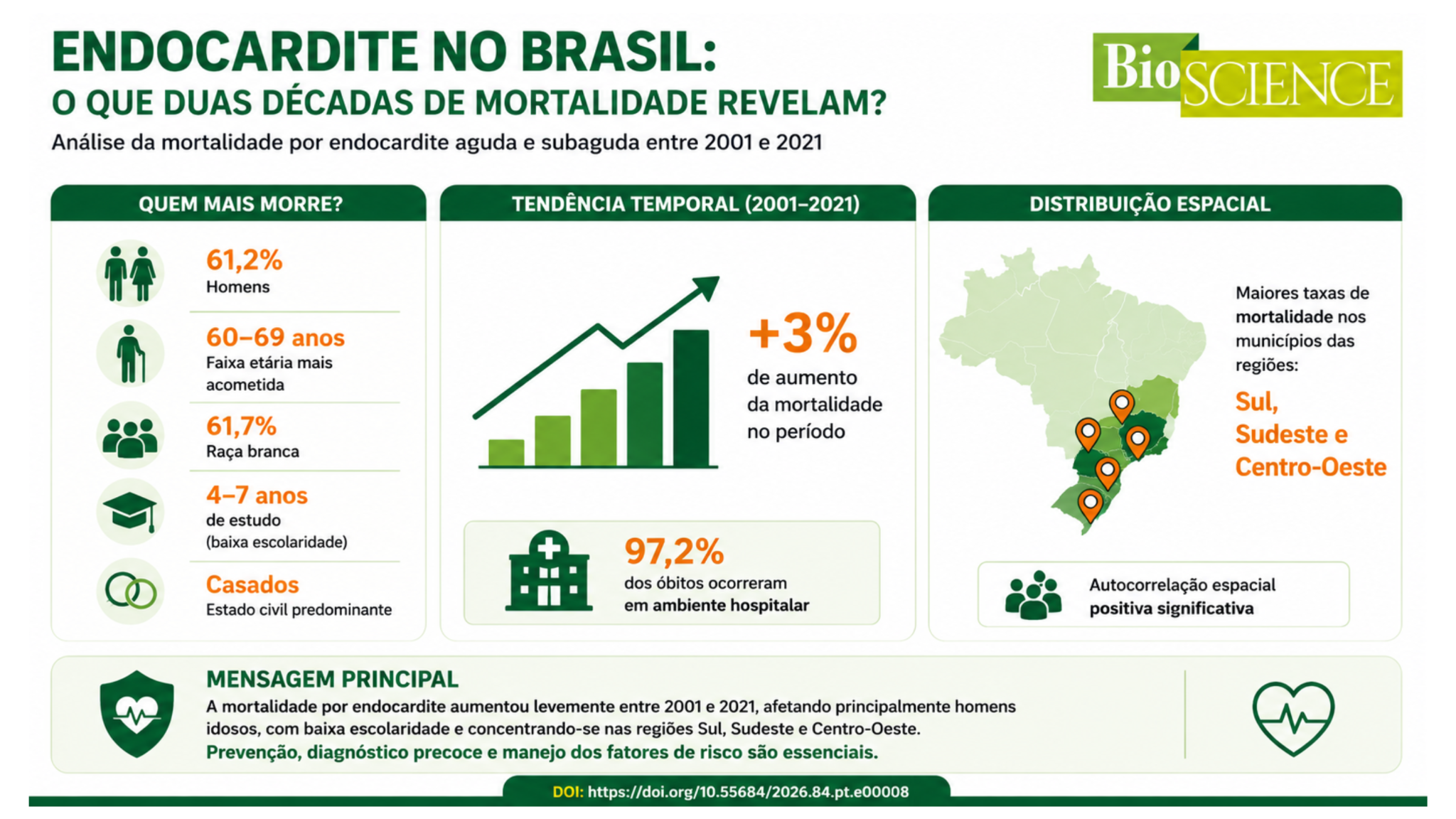
Results: Between 2001 and 2021, 15,448 deaths from acute and subacute endocarditis were recorded in Brazil, with an approximate increase of 3% in mortality over the period. The highest frequency was observed in individuals aged 60–69 years (21,22%), males (61,20%), white (61,67%), with low schooling (4–7 years of schooling) and married marital status. Most deaths occurred in a hospital environment (97.24%). The spatial analysis showed a higher concentration of mortality in the South and Southeast regions, with emphasis on specific municipalities. There was significant positive spatial autocorrelation.
Conclusion: Mortality from endocarditis showed a slight increase in the period studied, concentrated in vulnerable population groups and in specific regions of the country, reinforcing the need for regional strategies for prevention, early diagnosis, and adequate management of cardiovascular risk factors.
Article Details
Issue
Section

This work is licensed under a Creative Commons Attribution 4.0 International License.
References
Alves SG, Pivatto F, Filippini FB, Dannenhauer GP, Seroiska G, Bischoff HM, et al, Desempenho do Escore SHARPEN e do Índice de Comorbidade de Charlson para Predição de Mortalidade durante a Internação Hospitalar e após a Alta na Endocardite Infecciosa. Arquivos Brasileiros de Cardiologia. 2023;120(12):e20230441. https://doi.org/10.36660/abc.20230441
Urina-Jassir M, Jaimes-Reyes MA, Martinez-Vernaza S, Quiroga-Vergara C, Urina-Triana M. Clinical, Microbiological, and Imaging Characteristics of Infective Endocarditis in Latin America: A Systematic Review. Int J Infect Dis. 2022;117:312-21. https://doi.org/10.1016/j.ijid.2022.02.022
Jorge MS, Rodrigues AJ, Vicente WVA, Evora PRB. Cirurgia de Endocardite Infecciosa, Análise de 328 Pacientes Operados em um Hospital Universitário Terciário. Arquivos Brasileiros de Cardiologia. 2023;120:e20220608. https://doi.org/10.36660/abc.20220608
Rajani R, Klein JL. Infective endocarditis: A contemporary update. Clin Med (Lond). 2020;20(1):31-5. https://doi.org/10.7861/clinmed.cme.20.1.1
Yang X, Chen H, Zhang D, Shen L, An G, Zhao S. Global magnitude and temporal trend of infective endocarditis, 1990-2019: results from the Global Burden of Disease Study. Eur J Prev Cardiol. 2022;29(8):1277-86. https://doi.org/10.1093/eurjpc/zwab184
da Cruz Lamas C. Endocardite Infecciosa: Ainda uma Doença Mortal. Arquivos Brasileiros de Cardiologia. 2020;114(1):9-11; https://doi.org/10.36660/abc.20190809
Dong C, Bu X, Liu J, Wei L, Ma A, Wang T. Cardiovascular disease burden attributable to dietary risk factors from 1990 to 2019: A systematic analysis of the Global Burden of Disease study. Nutr Metab Cardiovasc Dis. 2022;32(4):897-907. https://doi.org/10.1016/j.numecd.2021.11.012
Prendki V. Management of elderly patients with infective endocarditis. Clin Microbiol Infect. 2019;25(10):1169-70. https://doi.org/10.1016/j.cmi.2019.06.023
Stringhini S, Carmeli C, Jokela M, Avendaño M, Muennig P, Guida F, et al. Socioeconomic status and the 25 × 25 risk factors as determinants of premature mortality: a multicohort study and meta-analysis of 1·7 million men and women. Lancet. 2017;389(10075):1229-37. https://doi.org/10.1016/s0140-6736(16)32380-7
Marmot M, Allen J, Bell R, Bloomer E, Goldblatt P. Consortium for the European Review of Social Determinants of Health and the Health Divide. WHO European review of social determinants of health and the health divide. Lancet. 2012;380(9846):1011-29. https://doi.org/10.1016/s0140-6736(12)61228-8
Havranek EP, Mujahid MS, Barr DA, Blair IV, Cohen MS, Cruz-Flores S, et al. American Heart Association Council on Quality of Care and Outcomes Research, Council on Epidemiology and Prevention, Council on Cardiovascular and Stroke Nursing, Council on Lifestyle and Cardiometabolic Health, and Stroke Council. Social Determinants of Risk and Outcomes for Cardiovascular Disease: A Scientific Statement From the American Heart Association. Circulation. 2015;132(9):873-98. https://doi.org/10.1161/cir.0000000000000228
Schroeder SA. Shattuck Lecture. We can do better--improving the health of the American people. N Engl J Med. 2007;357(12):1221-8. https://doi.org/10.1056/nejmsa073350