










The silent flame of obesity: Inflammation and risk for diabetes
Article Sidebar
Main Article Content
Abstract
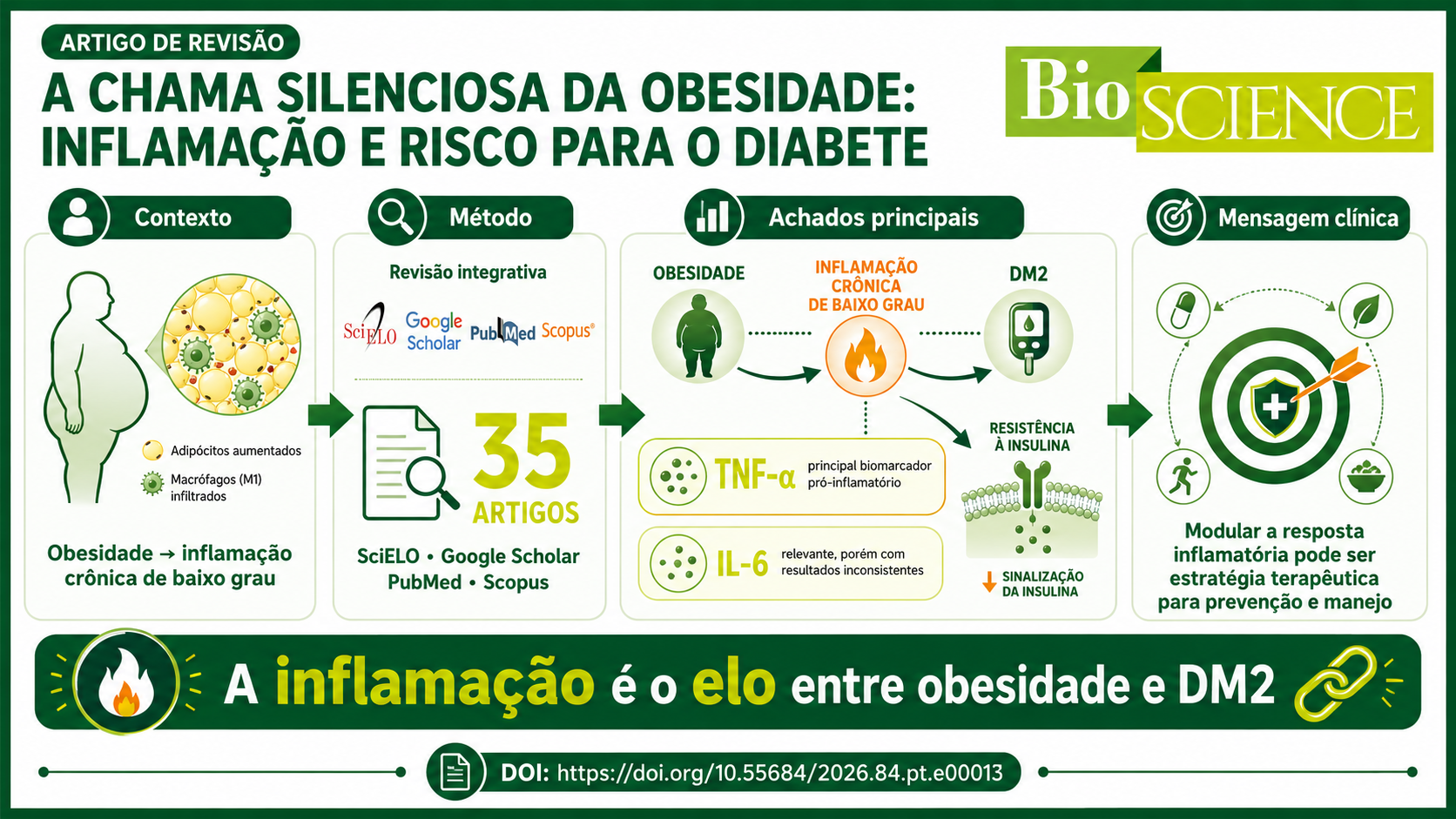
Introduction: It is important to have a thorough understanding of the inflammatory processes involved in obesity and type 2 diabetes mellitus, aiming to contribute to the development of new therapeutic and control strategies capable of modulating the inflammatory response associated with them.
Objective: To gain a deeper understanding of the inflammatory processes involved in obesity and type 2 diabetes mellitus.
Method: An integative literature review was conducted using information published on online platforms in Portuguese and English. The material for reading and analysis was selected from the SciELO, Google Scholar, PubMed, and Scopus platforms. Initially, a search was performed using the descriptors "obesity, type 2 diabetes mellitus, TNF-α, IL-6" with AND or OR searches, considering the title and/or abstract. Afterwards, considering only those most closely related to the topic, the full texts were read.
Result: Thirty-five articles that met the inclusion criteria were evaluated.
Conclusion: TNF-α expression is significantly increased in obese and diabetic animals compared to controls. IL-6, however, requires further investigation, especially in the context of obesity and diabetes in animal models. The studies reinforce the central role of TNF-α in inflammation associated with obesity and type 2 diabetes mellitus, validating its usefulness as a more sensitive biomarker.
Article Details
Issue
Section

This work is licensed under a Creative Commons Attribution 4.0 International License.
References
Pan WW, Myers MG Jr. Leptin and the maintenance of elevated body weight. Nat Rev Neurosci. 2018;19(2):95-105. https://doi.org/10.1038/nrn.2017.168
Rimes-Dias KA, Costa JC, Canella DS. Obesity and health service utilization in Brazil: data from the National Health Survey. BMC Public Health. 2022;22(1):1474. https://doi.org/10.1186/s12889-022-13906-2
Nilson EAF, Jaime PC, Venancio SI, et al. Trend in the prevalence of overweight and obese adults in São Paulo, Brazil: analysis between the years 2006 and 2019.PLoS One. 2025;20(1):e0308751.https://doi.org/10.1371/journal.pone.0308751
Ferrari G, Giannichi B, Resende B, Paiva L, Falbel F, Rache B, et al. The economic burden of overweight and obesity in Brazil: perspectives for the Brazilian Unified Health System. Public Health. 2022;207:82-7. https://doi.org/10.1016/j.puhe.2022.03.015
Gkrinia EMM, Belančić A. The mechanisms of chronic inflammation in obesity and potential therapeutic strategies: a narrative review. Curr Issues Mol Biol. 2025;47(5):357. https://doi.org/10.3390/cimb47050357
Rohm TV, Meier DT, Olefsky JM, Donath MY. Inflammation in obesity, diabetes, and related disorders. Immunity. 2022;55(1):31-55. https://doi.org/10.1016/j.immuni.2021.12.013
Swinburn BA, Kraak VI, Allender S, Atkins VJ, Baker PI, Bogard JR, et al. The global syndemic of obesity, undernutrition, and climate change: The Lancet Commission report. Lancet. 2019;393(10173):791-846. https://doi.org/10.1016/S0140-6736(18)32822-8
Aloke C, Ugwuja EI, Aja PM, Obasi NA, Chukwu J, akumadu BO, et al. Current advances in the management of diabetes mellitus. Biomedicines. 2022;10(10):2436. https://doi.org/10.3390/biomedicines10102436
Vybhavi VSJ, Bhavsar M, Gusani J, Gohil Y, Paul NK, Garlapati HR, et al. New insights into the pathophysiology of type 2 diabetes: a review article. J Pharm Bioallied Sci. 2025;17(Suppl 2):S1070-2. https://doi.org/10.4103/jpbs.jpbs_205_24
Galindo RJ, Trujillo JM, Wang CCL, McCoy RG. Advances in the management of type 2 diabetes in adults. BMJ Med. 2023;2(1):e000372. https://doi.org/10.1136/bmjmed-2022-000372
Sapra A, Bhandari P. Diabetes. In: StatPearls. Treasure Island (FL): StatPearls Publishing; 2025. Disponível em: https://www.ncbi.nlm.nih.gov/books/NBK551501/
ElSayed NA, Aleppo G, Aroda VR, Bannuru R, Brown FM, Bruemmer D, et al. Glycemic targets: Standards of care in diabetes-2023. Diabetes Care. 2023;46(Suppl 1):S97-S110. https://doi.org/10.2337/dc23-S006
Donath MY, Shoelson SE. Type 2 diabetes as an inflammatory disease. Nat Rev Immunol. 2011;11(2):98-107. https://doi.org/10.1038/nri2925
Plagemann A, Heidrich I, Gotz F, Rohde W, Dorner G. Lifelong enhanced diabetes susceptibility and obesity after temporary intrahypothalamic hyperinsulinism during brain organization. Exp Clin Endocrinol. 1992;99(2):91-5. https://doi.org/10.1055/s-0029-1211143
Velkoska E, Cole TJ, Dean RG, Burrell LM, Morris MJ. Early undernutrition leads to long-lasting reductions in body weight and adiposity whereas increased intake increases cardiac fibrosis in male rats. J Nutr. 2008;138(9):1622-7. https://doi.org/10.1093/jn/138.9.1622
Coupé B, Ishii Y, Dietrich MO, Komatsu M, Horvath TL, Bouret SG. Loss of autophagy in pro-opiomelanocortin neurons perturbs axon growth and causes metabolic dysregulation. Cell Metab. 2012;15(2):247-55. https://doi.org/10.1016/j.cmet.2011.12.016
Habbout A, Li N, Rochette L, Vergely C. Postnatal overfeeding in rodents by litter size reduction induces major short- and long-term pathophysiological consequences. J Nutr.2013;143(5):553-62. ps://doi.org/10.3945/jn.112.172825
Tabushi FT, Scomparin RC, Machado RS, Oliveira BC, Silva-Filho VJ, Coelho FF, et al. Vertical gastrectomy in overweight and non-overweight rats. Acta Cir Bras. 2016;31(10):689-96. https://doi.org/10.1590/S0102-865020160100000008
Mattaraia VGM, da Silva APR, Sartori DR da S, Tavora M de FCLF, Rodrigues VB, Moreira VB, et al. Efeito macho na indução do estro em ratas Wistar (Rattus norvegicus). Vet Zootec. 2009;16(4):669-77. Disponível em: https://rvz.emnuvens.com.br/rvz/article/view/1266
Silva VD, Nogueira RMB. Diabetes mellitus experimental induzido com aloxana em ratos Wistar. Rev Ciênc Farm Básica Apl. 2015;36(1):9-15.
Szkudelski T. The mechanism of alloxan and streptozotocin action in B cells of the rat pancreas. Physiol Res. 2001;50(6):537-46.
Takada J, Machado MA, Peres SB, Brito LC, Borges-Silva CN, Costa CEM, et al. Neonatal streptozotocin-induced diabetes mellitus: a model of insulin resistance associated with loss of adipose mass. Metabolism. 2007;56(7):977-84. https://doi.org/10.1016/j.metabol.2006.05.021
McNeill JH, editor. Modelos experimentais de diabetes. New York: Routledge; 2018. Disponível em: https://www.niddk.nih.gov/health-information/health- statistics/overweight-obesity
Hotamisligil GS. Inflammation and metabolic disorders. Nature. 2006;444(7121):860-7. https://doi.org/10.1038/nature05485
Erta M, Quintana A, Hidalgo J. Interleukin-6, a major cytokine in the central nervous system. Int J Biol Sci. 2012;8(9):1254-66. https://doi.org/10.7150/ijbs.4679
Scheller J, Chalaris A, Schmidt-Arras D, Rose-John S. The pro- and anti- inflammatory properties of the cytokine interleukin-6. Biochim Biophys Acta. 2011;1813(5):878-88. https://doi.org/10.1016/j.bbamcr.2011.01.034
Febbraio MA, Pedersen BK. Muscle-derived interleukin-6: mechanisms and implications. FASEB J. 2002;16(11):1335-47. https://doi.org/10.1096/fj.01- 0876rev
Mohammadi M, Gozashti MH, Aghadavood M, Mehdizadeh MR, Hayatbakhsh MM. Clinical significance of serum IL-6 and TNF-α levels in patients with metabolic syndrome. Rep Biochem Mol Biol. 2017;6(1):74-9. https://pmc.ncbi.nlm.nih.gov/articles/PMC5643447/
Kern PA, Ranganathan S, Wood L, Ranganathan G. Adipose tissue tumor necrosis factor and interleukin-6 expression in human obesity and insulin resistance. Am J Physiol Endocrinol Metab. 2001;280(5):E745-51. https://doi.org/10.1152/ajpendo.2001.280.5.E745
Lenzen S. The mechanisms of alloxan- and streptozotocin-induced diabetes. Diabetologia. 2008;51(2):216-26. https://doi.org/10.1007/s00125-007-0886-7
Yang H, Scheff AJ, Schalch DS. Effects of streptozotocin-induced diabetes mellitus on growth and hepatic insulin-like growth factor I gene expression in the rat. Metabolism. 1990;39(3):295-301. https://doi.org/10.1Furman BL. Streptozotocin-induced diabetic models in mice and rats. Curr Protoc Pharmacol. 2015;70:5.47.1-20. https://doi.org/10.1002/0471141755.ph0547s70
Ganda OP, Rossini AA, Like AA. Studies on streptozotocin diabetes. Diabetes. 1976;25(5):595-603. https://doi.org/10.2337/diab.25.7.595
Furman BL. Streptozotocin-induced diabetic models in mice and rats. Curr Protoc Pharmacol. 2015;70:5.47.1-20. https://doi.org/10.1002/0471141755.ph0547s70
Hotamisligil GS. Foundations of immunometabolism and implications for metabolic health and disease. Immunity. 2017;47(3):406-420. doi: http://doi.org/10.1016/j.immuni.2017.08.009
Akash MS, Rehman K, Chen S. Role of inflammatory mechanisms in pathogenesis of type 2 diabetes mellitus. J Cell Biochem. 2013;114(3):525-31. https://doi.org/10.1002/jcb.24402