










Lobular breast carcinoma after covid-19: What has changed in prevalence and molecular profile?
Article Sidebar
Main Article Content
Abstract
Introduction: Invasive lobular carcinoma (CLI) is a type of cancer that originates in the mammary glands. It is distinguished by presenting multiple histological and molecular patterns, with the main subtypes being luminal (A and B) and triple negative. The COVID-19 pandemic has significantly impacted health services, with the suspension of elective operations and the prioritization of care for severe cases.
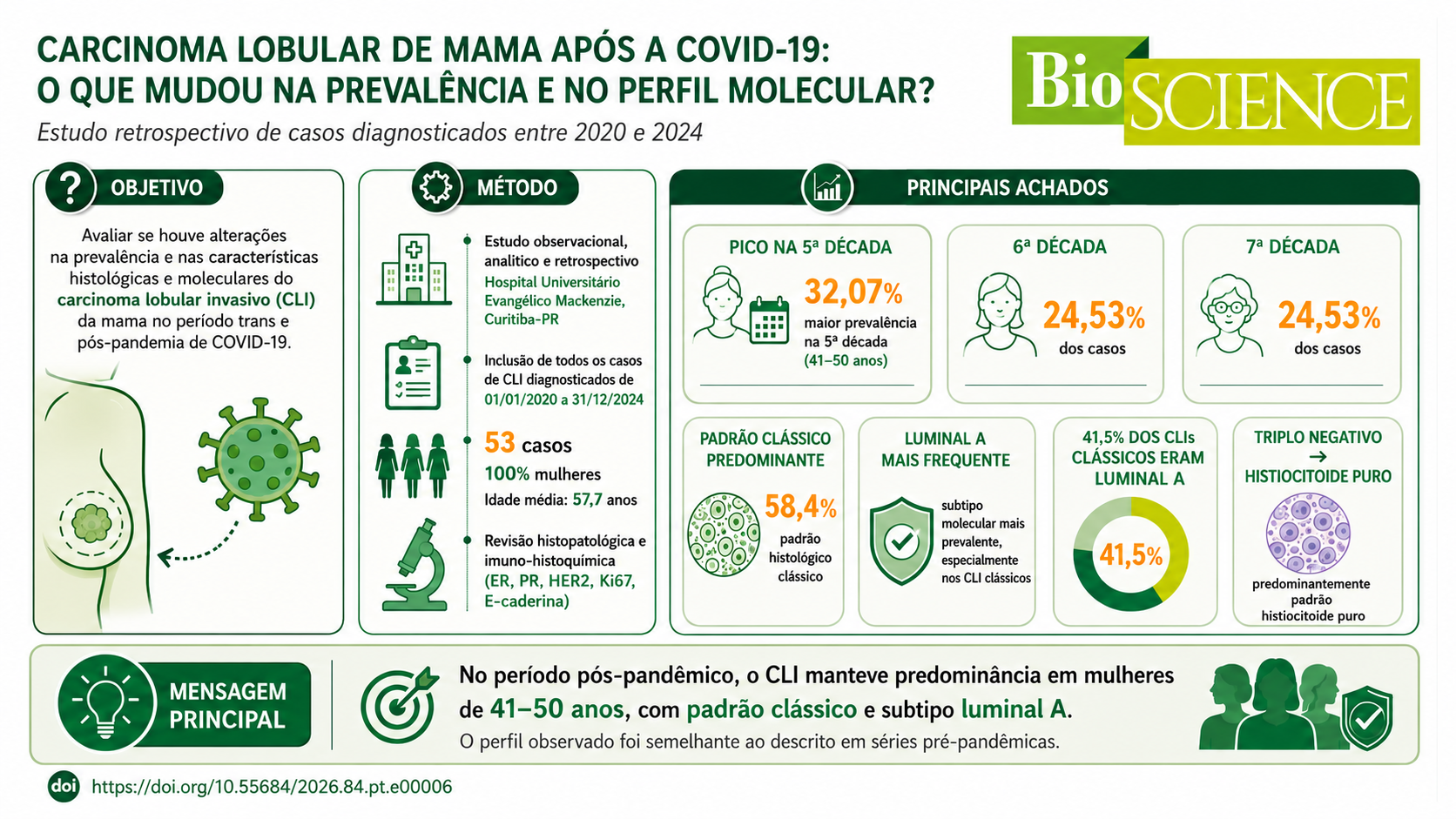
Objective: To evaluate the possible changes in the prevalence and characteristics of CLI in the post-pandemic period, with emphasis on the distribution by age group, histological patterns, and molecular subtypes.
Method: The prevalence of carcinoma was identified by core biopsy and/or segmental resection of the breast, within the histological standards of lobular carcinomas, and the comparison of histological findings was based on the immunohistochemical profile of the tumors (molecular classification).
Results: The highest prevalence was between the fifth and seventh decades, peaking in the fifth (41-50 years) similar to pre-pandemic data. The classic histological pattern of the CLI was the most common in all age groups. Among the classical CLIs, luminal molecular subtype A was the most prevalent. There was no statistically significant difference between the prevalence of luminal CLI B and triple negative. Triple-negative tumors predominantly exhibited the pure histiocytoid pattern.
Conclusion: There was a higher prevalence of CLI in women in the fifth decade, with a predominance of the classic pattern and the luminal subtype A in the post-pandemic period.
Article Details
Issue
Section

This work is licensed under a Creative Commons Attribution 4.0 International License.
References
Batra H, Mouabbi JA, Ding Q, Sahin AA, Raso MG. Lobular Carcinoma of the Breast: A Comprehensive Review with Translational Insights. Cancers (Basel). 2023;15(22):5491. https://doi.org/10.3390/cancers15225491
Ciriello G, Gatza ML, Beck AH, Wilkerson MD, Rhie SK, Pastore A, et al. Comprehensive Molecular Portraits of Invasive Lobular Breast Cancer. Cell. 2015;163(2):506-19. https://doi.org/10.1016/j.cell.2015.09.033
Ilić I, Cvetković J, Ilić R, Cvetković L, Milićević A, Todorović S, et al. Differences in Histological Subtypes of Invasive Lobular Breast Carcinoma According to Immunohistochemical Molecular Classification. Diagnostics (Basel). 2024;14(6):660. https://doi.org/10.3390/diagnostics14060660
Loibl S, Poortmans P, Morrow M, Denkert C, Curigliano G. Breast cancer. Lancet. 2021;397(10286):1750-69. https://doi.org/10.1016/s0140-6736(20)32381-3
Tsai ML, Lillemoe TJ, Finkelstein MJ, Money JE, Susnik B, Grimm E, et al. Utility of Oncotype DX Risk Assessment in Patients With Invasive Lobular Carcinoma. Clin Breast Cancer. 2016;16(1):45-50. https://doi.org/10.1016/j.clbc.2015.08.001
Wolff AC, Somerfield MR, Dowsett M, Hammond MEH, Hayes DF, McShane LM, et al. Human Epidermal Growth Factor Receptor 2 Testing in Breast Cancer: ASCO-College of American Pathologists Guideline Update. J Clin Oncol. 2023;41(22):3867-72. https://doi.org/10.1200/jco.22.02864
Fusco N, Ragazzi M, Sajjadi E, Venetis K, Piciotti R, Morganti S, et al. Assessment of estrogen receptor low positive status in breast cancer: Implications for pathologists and oncologists. Histol Histopathol. 2021;36(12):1235-45. https://doi.org/10.14670/hh-18-376
Desai A, Mohammed TJ, Duma N, Garassino MC, Hicks LK, Kuderer NM, et al. COVID-19 and Cancer: A Review of the Registry-Based Pandemic Response. JAMA Oncol. 2021;7(12):1882-90. https://doi.org/10.1001/jamaoncol.2021.4083
Allemani C, Sant M, Berrino F, Aareleid T, Chaplain G, Coebergh JW, et al. Prognostic value of morphology and hormone receptor status in breast cancer - a population-based study. Br J Cancer. 2004;91(7):1263-8. https://doi.org/10.1038/sj.bjc.6602153
Quinn RM, Bernal AM, Oh SY, Anampa JD. Trends in Incidence of Invasive Lobular Carcinoma of the Breast by Race: Patterns by Age, Cancer Stage, and Socioeconomic Factors in the United States, 1992-2019. Clin Breast Cancer. 2025; 25(4):394-402. https://doi.org/10.1016/j.clbc.2024.12.015
McCart Reed AE, Kalinowski L, Simpson PT, Lakhani SR. Invasive lobular carcinoma of the breast: the increasing importance of this special subtype. Breast Cancer Res. 2021;23(1):6. https://doi.org/10.1186/s13058-020-01384-6
Metzger-Filho O, Procter M, de Azambuja E, Leyland-Jones B, Gelber RD, Dowsett M, et al. Magnitude of trastuzumab benefit in patients with HER2-positive, invasive lobular breast carcinoma: results from the HERA trial. J Clin Oncol. 2013;31(16):1954-60. https://doi.org/10.1200/jco.2012.46.2440
Goldhirsch A, Winer EP, Coates AS, Gelber RD, Piccart-Gebhart M, Thürlimann B, et al. Personalizing the treatment of women with early breast cancer: highlights of the St Gallen International Expert Consensus on the Primary Therapy of Early Breast Cancer 2013. Ann Oncol. 2013;24(9):2206-23. https://doi.org/10.1093/annonc/mdt303
Wang Y, Hacking SM, Li Z, Graff SL, Yang D, Tan L, et al. Triple-negative Breast Carcinoma With Apocrine and Histiocytoid Features: A Clinicopathologic and Molecular Study of 18 Cases. Am J Surg Pathol. 2023;47(9):1011-8. https://doi.org/10.1097/pas.0000000000002073
Coty-Fattal Z, Minhas S, Butcher M, Agarwal I, LaBoy C, Blanco L, et al. Clinicopathologic and Immunophenotypic Classification of Invasive Lobular Carcinoma with Histiocytoid Features. Int J Surg Pathol. 2024;32(4):719-725. https://doi.org/10.1177/10668969231189714