










Icu and antimicrobial resistance: How to face an everincreasing challenge?
Article Sidebar
Main Article Content
Abstract
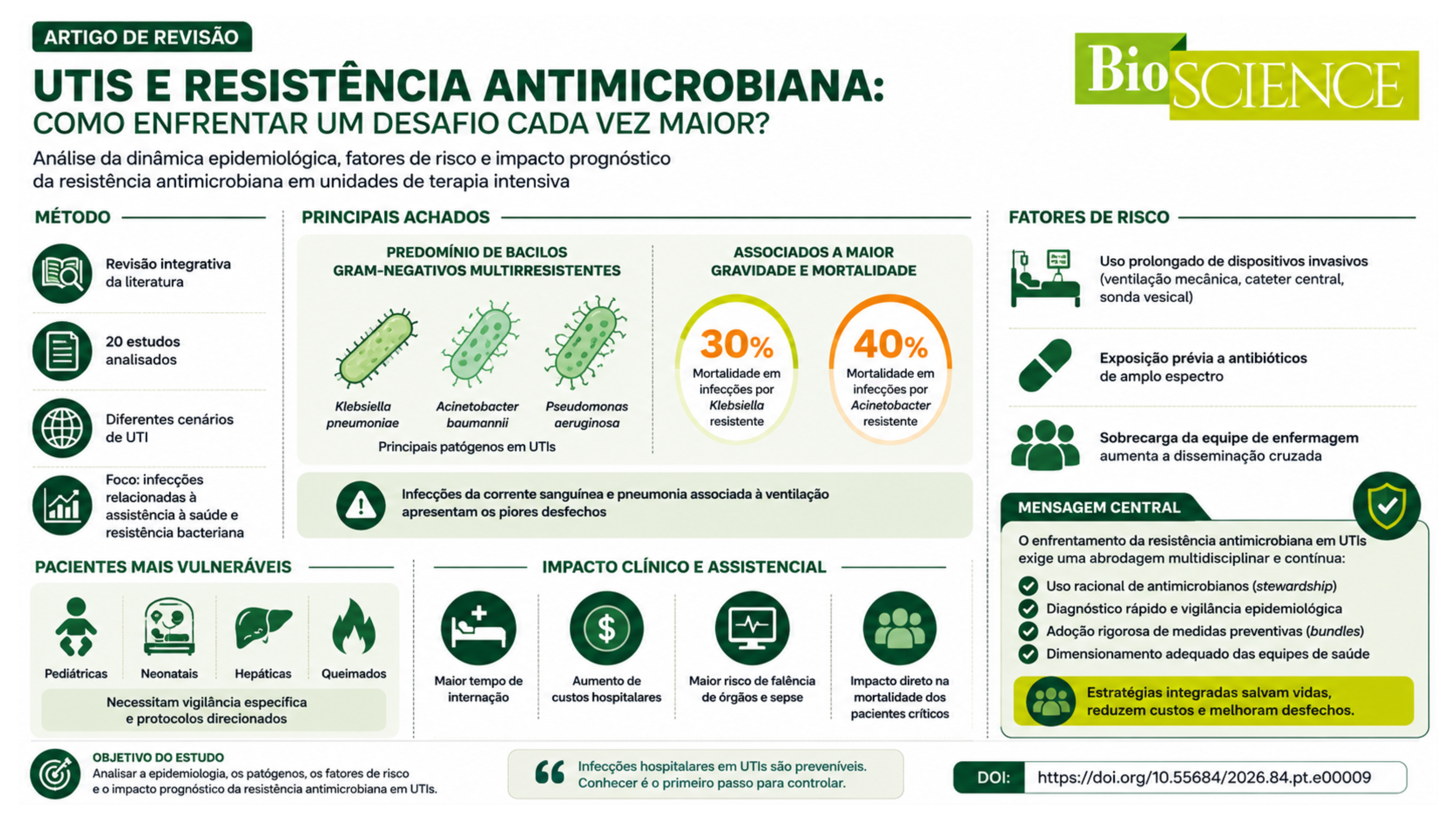
Introduction: Antimicrobial resistance in critical care units represents one of the main challenges of health care, associated with high morbidity and unfavorable prognostic impact.
Objective: To analyze the epidemiological dynamics, microbiological profile, risk factors, and prognostic impact of antimicrobial resistance in intensive care units, considering different patient profiles.
Method: This is an integrative literature review based on the analysis of 20 scientific articles that investigated healthcareassociated infections, pathogen prevalence, and bacterial resistance in different critical care settings.
Results: There was a predominance of gram-negative bacilli, especially microorganisms associated with high clinical severity, especially in ventilator-associated lung infections and bloodstream infections. Patients in specialized units, such as burns, pediatric, neonatal, and liver units, showed specific vulnerabilities. In addition, inadequacies in the nursing team sizing were associated with increased risk of microorganism dissemination.
Conclusion: The reduction of antimicrobial resistance in these contexts requires an integrated approach, including programs for the rational use of antimicrobials, incorporation of rapid diagnostic methods, strict adherence to preventive measures, and adequacy of the workload of health professionals.
Article Details
Issue
Section

This work is licensed under a Creative Commons Attribution 4.0 International License.
References
Carey AJ, Saiman L, Polin RA. Hospital-Acquired Infections in the NICU: Epidemiology for the New Millennium. Clin Perinatol. 2008;35(1):223-49. https://doi.org/10.1016/j.clp.2007.11.014
Al-Mousa HH, Omar AA, Rosenthal VD, Salama MF, Aly NY, Noweir ME, et al. Device-associated infection rates, bacterial resistance, length of stay, and mortality in Kuwait: International Nosocomial Infection Consortium findings. Am J Infect Control. 2016;44(4):444-9. https://doi.org/10.1016/j.ajic.2015.10.031
Yang J, Chen M, Li L, Zha Z, Cheng M, Yang X. Prognosis analysis and infection-related risk factors of multi-drug-resistant bacteria isolated from a general hospital in China, 2019-2023. J Hosp Infect. 2025;158:29-37. https://doi.org/10.1016/j.jhin.2025.02.003
Agaba P, Tumukunde J, Tindimwebwa JVB, Kwizera A. Nosocomial bacterial infections and their antimicrobial susceptibility patterns among patients in Ugandan intensive care units: a cross sectional study. BMC Res Notes. 2017;10(1):349. https://doi.org/10.1186/s13104-017-2695-5
Kollef MH, Burnham CAD. Ventilator-Associated Pneumonia: The Role of Emerging Diagnostic Technologies. Semin Respir Crit Care Med. 2017;38(3):253-63. https://doi.org/10.1055/s-0037-1599224
Zhou X, Wagh K, Lv G, Sharma D, Lei W. Genome drafting of nosocomial infection CRE Klebsiella pneumoniae confirming resistance to colistin and eravacycline, carrying blaNDM-1, mcr-1, and blaKPC-2 in neonatology from November to December 2023. Front Cell Infect Microbiol. 2025;14:1528017. https://doi.org/10.3389/fcimb.2024.1528017
Wang Z, Qin RR, Huang L, Sun LY. Risk Factors for Carbapenem-resistant Klebsiella pneumoniae Infection and Mortality of Klebsiella pneumoniae Infection. Chin Med J (Engl). 2016;129(10):1135-9. https://doi.org/10.4103/0366-6999.221267
Bonnet V, Dupont H, Glorion S, Aupée M, Kipnis E, Gérard JL, et al. Influence of bacterial resistance on mortality in intensive care units: a registry study from 2000 to 2013 (IICU Study). J Hosp Infect. 2019;102(3):317-24. https://doi.org/10.1016/j.jhin.2019.01.011
Elmanama AA, Al Laham NA, Tayh GA. Antimicrobial susceptibility of bacterial isolates from burn units in Gaza. Burns. 2013;39(8):1612-8. https://doi.org/10.1016/j.burns.2013.04.011
Öncül O, Öksüz S, Acar A, Ülkür E, Turhan V, Uygur F, et al. Nosocomial infection characteristics in a burn intensive care unit: Analysis of an eleven-year active surveillance. Burns. 2014;40(5):835-41. https://doi.org/10.1016/j.burns.2013.11.003
Santucci SG, Gobara S, Santos CR, Fontana C, Levin AS. Infections in a burn intensive care unit: experience of seven years. J Hosp Infect. 2003;53(1):6-13. https://doi.org/10.1053/jhin.2002.1340
Hassan EA, Elsherbiny NM, Abd El-Rehim AS, Soliman AMA, Ahmed AO. Health care-associated infections in pre-transplant liver intensive care unit: Perspectives and challenges. J Infect Public Health. 2018;11(3):398-404. https://doi.org/10.1016/j.jiph.2017.09.006
Kim B, Kim K, Yoon JS. Nosocomial Acinetobacter baumannii infection in children in adult versus pediatric intensive care units. Pediatr Int. 2020;62(4):451-58. https://doi.org/10.1111/ped.14133
Aycan IO, Celen MK, Yilmaz A, Almaz MS, Dal T, Celik Y, et al. Bacterial colonization due to increased nurse workload in an intensive care unit. Rev Bras Anestesiol. 2015;65(3):180-5. https://doi.org/10.1016/j.bjane.2014.05.005
Enoch DA, Summers C, Brown NM, Moore L, Gillham MI, Burnstein RM, et al. Investigation and management of an outbreak of multidrug-carbapenem-resistant Acinetobacter baumannii in Cambridge, UK. J Hosp Infect. 2008;70(2):109-18. https://doi.org/10.1016/j.jhin.2008.05.015
Sligl WI, Dragan T, Smith SW. Nosocomial Gram-negative bacteremia in intensive care: epidemiology, antimicrobial susceptibilities, and outcomes. Int J Infect Dis. 2015;37:129-34. https://doi.org/10.1016/j.ijid.2015.06.024
Mitharwal SM, Yaddanapudi S, Bhardwaj N, Gautam V, Biswal M, Yaddanapudi L. Intensive care unit-acquired infections in a tertiary care hospital: An epidemiologic survey and influence on patient outcomes. Am J Infect Control. 2016;44(10):113-7. https://doi.org/10.1016/j.ajic.2016.01.021
Nagao M. A multicentre analysis of epidemiology of the nosocomial bloodstream infections in Japanese university hospitals. Clin Microbiol Infect. 2014;20(12):1002-10. https://doi.org/10.1111/1469-0691.12083
Karakuzu Z, Iscimen R, Akalin H, Girgin NK, Kahveci F, Sinirtas M. Prognostic Risk Factors in Ventilator-Associated Pneumonia. Med Sci Monit. 2018;24:1321-8. https://doi.org/10.12659/msm.905919
Xu M, Zeng J. Analysis of factors influencing the risk of secondary infection in patients colonized or infected with multidrug-resistant Gram-negative bacteria following hospitalization. Microb Pathog. 2024;190:106637. https://doi.org/10.1016/j.micpath.2024.106637