










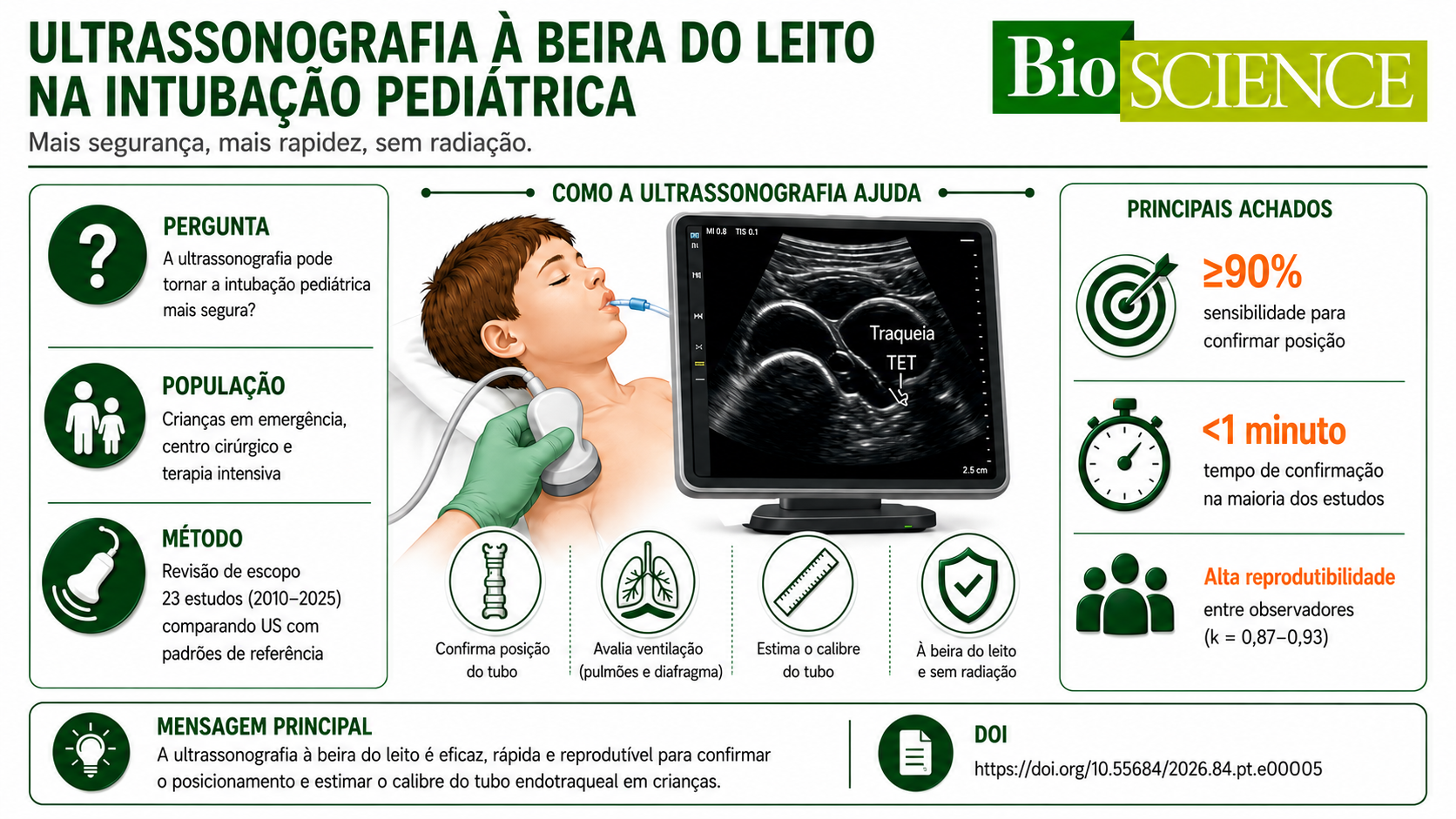
Can bedside ultrasound make pediatric intubation safer?
Article Sidebar
Main Article Content
Abstract
Introduction: Rapid and accurate confirmation of endotracheal tube positioning and caliber is critical in pediatric practice. Traditional methods, such as radiography and capnography, have limitations related to time, radiation exposure, and the inability to assess depth or selectivity.
Objective: To map and synthesize the evidence on the use of ultrasonography (US) to confirm the positioning, depth, and caliber of the endotracheal tube in pediatric populations.
Method: Scoping review conducted according to the PRISMA-ScR guidelines. The PubMed, Embase, and Cochrane Library databases were searched in September 2025, with no language restriction. Clinical studies comparing US with radiography, capnography, bronchoscopy, or anatomical formulas were included. Those with samples smaller than ten participants, exclusively adult populations, or simulations without clinical data were excluded. Two independent reviewers screened and extracted the data. The findings were narratively synthesized in five domains: tracheal versus esophageal distinction, depth and selectivity, caliber estimation, time to confirmation, and reproducibility.
Results: Were included 23 studies published between 2010 and 2025, covering emergency, operating room, and pediatric intensive care settings. Ultrasonography generally showed sensitivity ≥ 90% and confirmation times of less than one minute.
Conclusion: Bedside ultrasound is an effective, rapid, and reproducible method for confirming the positioning and estimating the caliber of the endotracheal tube in pediatrics. Large-scale implementation requires standardization of protocols and structured training.
Article Details
Issue
Section

This work is licensed under a Creative Commons Attribution 4.0 International License.
References
Gautam I, Angurana SK, Muralidharan J, Bansal A, Nallasamy K, Saxena A. Three-Point Ultrasonography for Confirmation of Endotracheal Tube Position in Children (TRUCE Study). Indian J Pediatr. 2025;92(5):495-501. https://doi.org/10.1007/s12098-023-05013-w
Baruah A, Ahmad Z, Waindeskar V, Jain S, Chanchlani R, Mandal P, et al. 5-point airway (5-AIR) ultrasound protocol for confirmation of endotracheal intubation and position in paediatric patients undergoing surgery: A prospective observational study. Indian J Anaesth. 2024;68(12):1068-74. https://doi.org/10.4103/ija.ija_682_24
Tessaro MO, Salant EP, Arroyo AC, Haines LE, Dickman E. Tracheal rapid ultrasound saline test (T.R.U.S.T.) for confirming correct endotracheal tube depth in children. Resuscitation. 2015;89:8-12. https://doi.org/10.1016/j.resuscitation.2014.08.033
Datta S, Sankar J, Pathak M, Tungal S, Kandasamy D, Dhochak N, et al. Diagnostic accuracy of airway ultrasound in confirming the endotracheal tube depth in critically ill children. Am J Emerg Med. 2024;85:52-8. https://doi.org/10.1016/j.ajem.2024.08.012
Wani TM, John J, Rehman S, Bhaskar P, Sahabudheen AF, Mahfoud ZR, et al. Point-of-care ultrasound to confirm endotracheal tube cuff position in relationship to the cricoid in the pediatric population. Paediatr Anaesth. 2021;31(12):1310-5. https://doi.org/10.1111/pan.14303
Guerder M, Maurin O, Merckx A, Foissac F, Oualha M, Renolleau S, et al. Diagnostic value of pleural ultrasound to refine endotracheal tube placement in pediatric intensive care unit. Arch Pediatr. 2021;28(8):712-17. https://doi.org/10.1016/j.arcped.2021.09.006
Bharathi BM, Somayaji S, Tulasi T, Sheriff NK, Bagliker JS. Prediction of Endotracheal Tube Size in Pediatric Population Using Ultrasonographic Subglottic Diameter and Age-Related Formulas: A Comparative Study. Anesth Essays Res. 2022;16(1):1-6. https://doi.org/10.4103/aer.aer_11_22
Pillai R, Kumaran S, Jeyaseelan L, George SP, Sahajanandan R. Usefulness of ultrasound-guided measurement of minimal transverse diameter of subglottic airway in determining the endotracheal tube size in children with congenital heart disease: A prospective observational study. Ann Card Anaesth. 2018;21(4):382-7. https://doi.org/10.4103/aca.aca_220_17
Gupta B, Ahluwalia P. Prediction of endotracheal tube size in the pediatric age group by ultrasound: A systematic review and meta-analysis. J Anaesthesiol Clin Pharmacol. 2022;38(3):371-83. https://doi.org/10.4103/joacp.joacp_650_20
Liu Y, Ma W, Liu J. Applications of Airway Ultrasound for Endotracheal Intubation in Pediatric Patients: A Systematic Review. J Clin Med. 2023;12(4):1477. https://doi.org/10.3390/jcm12041477
Congedi S, Savio F, Auciello M, Salvadori S, Nardo D, Bonadies L. Sonographic Evaluation of the Endotracheal Tube Position in the Neonatal Population: A Comprehensive Review and Meta-Analysis. Front Pediatr. 2022;10:886450. https://doi.org/10.3389/fped.2022.886450
Levkovitz O, Schujovitzky D, Stackievicz R, Fayoux P, Morag I, Litmanovitz I, et al. Ultrasound assessment of endotracheal tube depth in neonates: a prospective feasibility study. Arch Dis Child Fetal Neonatal Ed. 2023;109(1):94-9. https://doi.org/10.1136/archdischild-2023-325855
Dennington D, Vali P, Finer NN, Kim JH. Ultrasound confirmation of endotracheal tube position in neonates. Neonatology. 2012;102(3):185-9. https://doi.org/10.1159/000338585
Huang D, Watkins LA, Weinschreider J, Ghazi A, Wang H, Dadiz R. Simulation-based Ultrasound Curriculum for Novice Clinicians to Assess Neonatal Endotracheal Tube Position. J Med Ultrasound. 2022;31(1):40-7. https://doi.org/10.4103/jmu.jmu_143_21
Rajasekhar M, Moningi S, Patnaik S, Rao P. Correlation between ultrasound-guided subglottic diameter and little finger breadth with the outer diameter of the endotracheal tube in paediatric patients - A prospective observational study. Indian J Anaesth. 2018;62(12):978-83. https://doi.org/10.4103/ija.IJA_545_18
Lin MJ, Gurley K, Hoffmann B. Bedside Ultrasound for Tracheal Tube Verification in Pediatric Emergency Department and ICU Patients: A Systematic Review. Pediatr Crit Care Med. 2016;17(10):469-76. https://doi.org/10.1097/pcc.0000000000000907
Alonso Quintela P, Oulego Erroz I, Mora Matilla M, Rodríguez Blanco S, Mata Zubillaga D, Regueras Santos L. Utilidad de la ecografía comparada con la capnografía y la radiografía en la intubación traqueal [Usefulness of bedside ultrasound compared to capnography and X-ray for tracheal intubation]. An Pediatr (Barc). 2014;81(5):283-8. https://doi.org/10.1016/j.anpedi.2014.01.004
Jaeel P, Sheth M, Nguyen J. Ultrasonography for endotracheal tube position in infants and children. Eur J Pediatr. 2017;176(3):293-300. https://doi.org/10.1007/s00431-017-2848-5
Salvadori S, Nardo D, Frigo AC, Oss M, Mercante I, Moschino L, et al. Ultrasound for Endotracheal Tube Tip Position in Term and Preterm Infants. Neonatology. 2021;118(5):569-77. https://doi.org/10.1159/000518278
Zaytseva A, Kurepa D, Ahn S, Weinberger B. Determination of optimal endotracheal tube tip depth from the gum in neonates by X-ray and ultrasound. J Matern Fetal Neonatal Med. 2020;33(12):2075-80. https://doi.org/10.1080/14767058.2018.1538350
Recker F, Kipfmueller F, Wittek A, Strizek B, Winter L. Applications of Point-of-Care-Ultrasound in Neonatology: A Systematic Review of the Literature. Life (Basel). 2024;14(6):658. https://doi.org/10.3390/life14060658
Saravia A, Saravia RW, Mudd P, Jones JW. Examining the pediatric subglottic airway by ultrasound: A systematic review. Int J Pediatr Otorhinolaryngol. 2023;166:111482. https://doi.org/10.1016/j.ijporl.2023.111482
Yang JL, Zheng F, Zhu KL, Wang W, Ding LM, Wang CG. Utilizing ultrasonography to determine the minimal transverse diameter of the subglottic airway for informed selection of reinforced cuffed endotracheal tube models in children. Eur Arch Otorhinolaryngol. 2024;281(12):6533-8. https://doi.org/10.1007/s00405-024-08923-3